
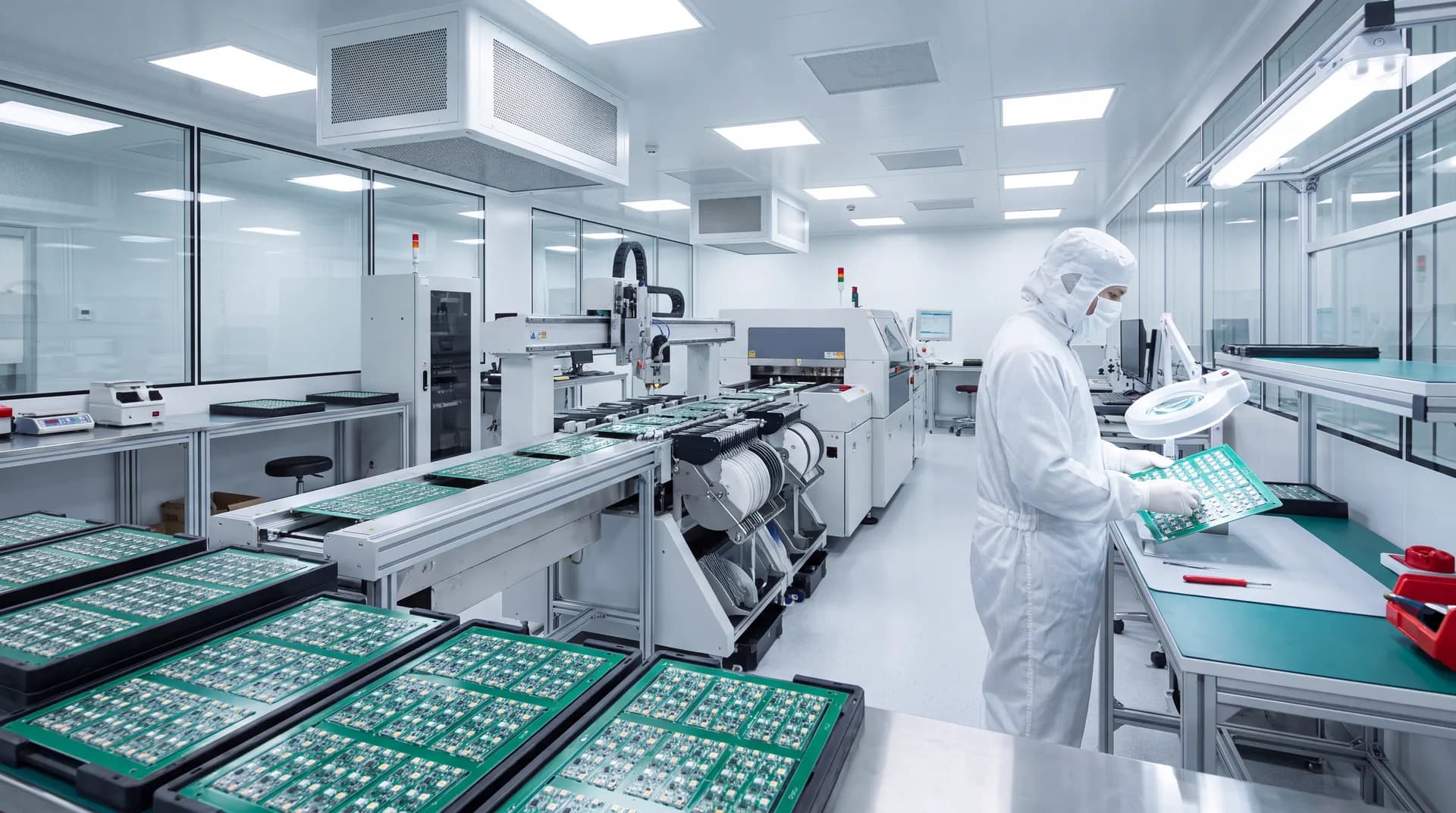
The Foundry
Where light is engineered — from the chip up.
Most display companies buy panels and resell them. SAVC designs the surface, engineers the structure behind it, and builds it on genuine Nichia silicon from a lineage that runs through a real semiconductor fab. The Foundry is where those three disciplines meet on one drawing.
Silicon to skyline
Design, engineering and manufacturing are usually three companies and three hand-offs. Here they are one team, which is why the emitter at the back of a pixel and the sightline from the street are decided in the same room.
Design
01We start where the architect starts, with the building, the sightlines and the night-time intent, not a catalogue of panels.
- Day- and night-time simulation of the finished surface
- Pixel-pitch and transparency studies tied to real viewing distances
- Brightness curves modelled against the site’s own ambient light
- A lookbook the whole design team can sign off
Engineering
02Between the concept and the crane sits the engineering that decides whether a display survives a decade outdoors.
- Mounts and secondary steel for curved, faceted and irregular envelopes
- Wind load, ingress protection and thermal path engineered per site
- Power and data redundancy sized to protected uptime
- Control and CMS roles mapped before a cabinet is built
Silicon & manufacturing
03SAVC’s lineage runs through a real semiconductor fab, so the emitter, the binning and the build are ours to control, not a distant supplier’s.
- Genuine Nichia emitters, specified at the front of the build
- Sub-binning tighter than the factory bins for one continuous surface
- Multi-stage burn-in that forces early failures in the factory
- Sealed cabinets, 16-bit drivers and conformal coating as standard
How a project takes shape
Every SAVC project moves through six stages, and each one closes on an approvable deliverable, so the design team, the engineers and the client are signing off the same thing at every step.
- 01
Discovery
Architecture, users, neighbours and rules; power and data routes.
Deliverable:Discovery brief
- 02
Concept & simulation
Day / night simulations, pitch and transparency study, brightness curves.
Deliverable:Lookbook
- 03
Engineering
Mounts, wind / IP / thermal, redundancy, CMS roles.
Deliverable:Shop drawings
- 04
Prototyping
On-site or sample mock-up.
Deliverable:Approved spec
- 05
Commissioning
HSE, access, on-site calibration, SAT.
Deliverable:As-builts + SAT report
- 06
Monitoring
Monitoring, preventive-maintenance plan, content playbook, SLA.
Deliverable:Ops dashboard
Who we sit with
A media surface is never delivered alone. We work inside the project team from the first sketch, so power, structure, control and content are resolved together, not renegotiated on site.
Built to solve the hard ones
The standard rectangle is the easy case. The Foundry exists for the projects that break it: the curved, the transparent, the never-before-attempted.
Non-standard geometry
Curved, faceted, spherical and mesh surfaces where a flat rectangle will not do, with content remapped per node to read correctly from the ground.
Transparency engineering
Balancing see-through, brightness, pixel pitch and structural load so a façade reads as glass by day and a media surface after dark.
On-site prototyping
Sample and full-scale mock-ups on the actual building, so the approved spec is proven in place before a single production cabinet is made.
Calibration & colour
Module-level colour and brightness verification, then on-site calibration at commissioning, so thousands of tiles read as one continuous picture.
Transparency engineering, live
Drag transparency and pixel pitch to watch the trade-off the lab resolves on every façade: see-through glass by day against media brightness by night. Switch the form factor and the day or night state to feel how the same envelope reads two ways.
Simulated IRISin Flexpix media façade, at night, at 60% transparency and roughly 100 mm pixel pitch, playing Ambient Loop.
Content preview
Playing nowA media façade is a programmable surface. Content plays across the building and can change by time of day or event. Preview how different content reads on the façade; select an item to play it here.
Drag to see the building read through the pixels. Higher transparency trades night-time density for daytime views.
Coarser pitch means larger pixels and lower resolution: sparser, more transparent, read from farther away. Finer pitch resolves sharper content up close. Values are illustrative.
Point pixel-clusters on flexible carriers for free-form envelopes.
Bring us the difficult one.
The building everyone else called impossible, the geometry with no flat face, the site with no forgiveness. Tell us the constraint and the ambition. We respond with a scoped, engineered answer.