
Design · July 12, 2026 · 6 min read
What the Gulf is teaching the world about media façades
Nowhere has turned buildings into screens faster than the UAE and Saudi Arabia. The region’s landmark façades are a live lesson in what architectural LED actually has to solve: extreme heat, the transparency trade-off, and a skyline treated as a national asset.
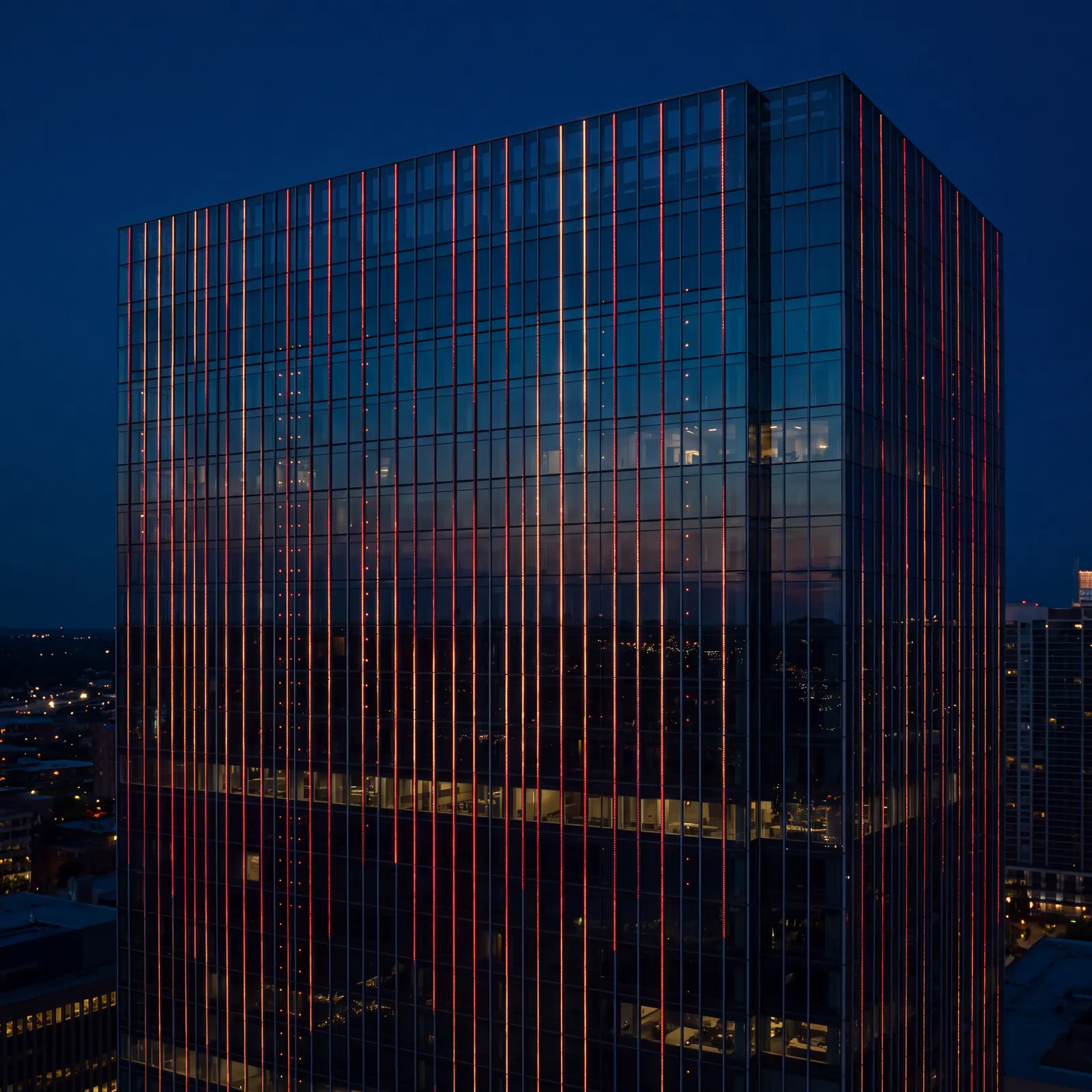
If you want to see where architectural LED is heading, watch the Gulf. In little more than a decade the UAE and Saudi Arabia have turned entire towers (and in some cases whole districts) into programmable media surfaces, and the illuminated skyline has become a deliberate piece of national identity. The engineering lessons that come out of building at that pace, in that climate, apply anywhere.
The building is the screen
The defining shift is away from bolted-on signage toward media architecture: light designed into the building envelope rather than applied to it. A tower façade that reads as glass by day and resolves into imagery after dark; a mesh surface that doubles as a sunshade; a landmark arch that changes colour to give a city its night-time signature. These are architecture first and display second, and they only work when the display engineer is in the room with the architect early, not handed a finished façade to retrofit.
Transparency is an engineering decision
The signature format is transparent mesh or grid LED: see-through glass by day, a media surface by night. But transparency is a trade, not a free lunch. Every point of see-through you preserve costs pixel density and peak brightness; the open grid that keeps the view also cuts wind load and lets heat escape. Balancing transparency, luminance, pixel pitch and structural load is the core tension of an architectural façade, and there is no universal answer, only the right one for a given building.
Engineered for 50 °C, not 25 °C
A façade here faces a worst-case environment: 50 °C-plus ambient, heat-soak by day and rapid cooling at night that works every seal and adhesive, airborne dust that abrades coatings, and a sun bright enough to demand very high daytime luminance just to stay legible. A panel rated for a temperate climate is the wrong product. This is where thermal design, genuine ingress protection and a display-grade emitter stop being line items and become the difference between a façade that lasts a decade and one that fades in a season.
A skyline is identity infrastructure
The most useful reframe from the Gulf is that a landmark façade is not advertising. It is identity. When a building’s after-dark signature is a tourism and brand asset, the stakes on uptime, colour consistency and visual quality rise with it. And because these façades run as programmable canvases — scheduled content, live events, city-scale synchronisation — the control platform matters as much as the diodes. The hardware is only half the system.
The building is the screen, the skyline is the brand, and the climate is unforgiving, which is exactly what makes the Gulf the clearest teacher of what architectural LED has to solve.
None of this is unique to one region; it is simply concentrated there. Architectural integration, the transparency trade-off, extreme-climate reliability, and a skyline treated as identity are demands every serious architectural project will eventually make. The Gulf is just making them first, and at scale, which is why it is worth studying wherever your next façade goes up.
Bring it to your site
Have a project in mind?
Our team turns these principles into a scoped, specified system for your building.
More from Signal
Market · July 12, 2026
The operator’s screen: what North America’s DOOH market demands
North America is the world’s largest, most mature out-of-home market, and a distinctly operator-driven one. When a display is contracted advertising inventory sold by the second, the hardware spec starts to read like a financial document.
Engineering · July 11, 2026
Four forcing functions that decide whether an outdoor screen survives
Heat, salt, dust and duty cycle rarely test a display one at a time. In the world’s harshest sites they arrive together. And it’s the combination, not any single stress, that separates a ten-year screen from a three-year one.