
Engineering · July 9, 2026 · 6 min read
The hardest screen in sport: engineering the stadium display
A stadium isn’t one screen. It’s a system of them. And the toughest spec on the list is set not by the crowd, but by the broadcast camera. Here is what makes venue displays their own engineering discipline.
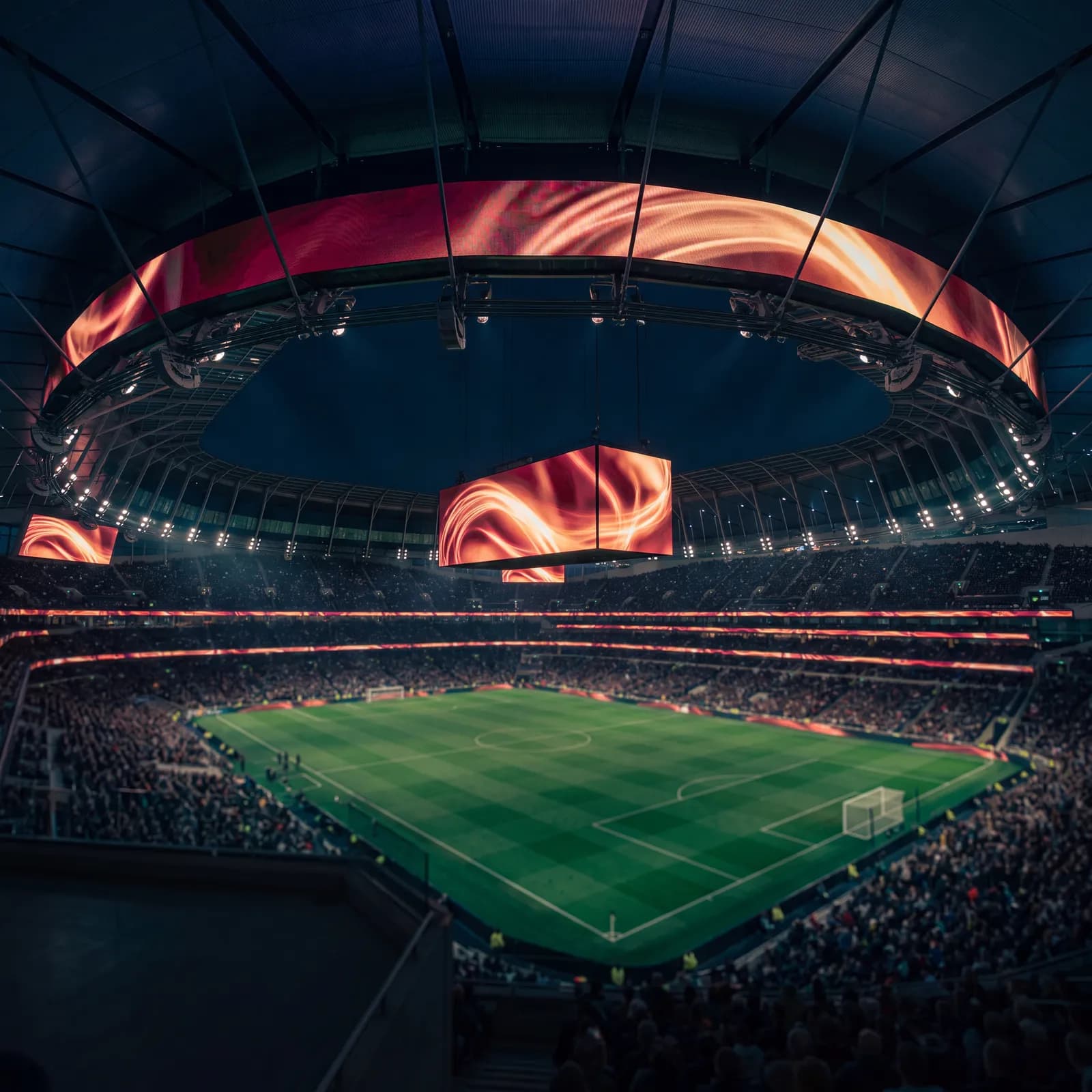
A stadium display looks like one big screen and is really a system of them. A single bowl can carry a centre-hung video board, a ribbon of fascia displays wrapping the tiers, pitch-side perimeter boards, and sometimes a façade. Each is a different engineering problem with its own pixel pitch, brightness and ruggedisation. Getting the ensemble to behave as one coherent picture is the actual job.
The camera sets the refresh rate, not the eye
This is the most counterintuitive spec in the venue. A human viewer is comfortable at fairly modest refresh rates; a broadcast camera is not. Standard refresh produces scan-line banding and flicker on camera, worst of all in super-slow-motion replay, where a single moment is stretched across many frames. That is why a broadcast refresh rate of at least 3,840 Hz has become the working baseline for televised venues, with the top tier climbing higher still for HDR. The test that matters is not how the wall looks from the stands; it is how it looks through the camera that shows it to millions. Run a real broadcast-camera flicker check on site before sign-off.
Brightness is a moving target across a single day
An open-air bowl in direct sun needs several thousand nits — often 6,000 to 8,000 — just to stay legible. The same screen at night, at full output, would blind the front rows and blow out the cameras. So brightness is not a fixed number; it is an auto-dimming curve tied to ambient light, holding legibility at noon and comfort after dark.
The panel is part of the field of play
Pitch-side perimeter boards are the hardest case, because players run into them. They need a soft front mask, rounded and cushioned edges, and geometry that meets the contact-sport safety requirements the game’s governing bodies impose, all while surviving ball strikes and playing through rain behind IP-rated sealing. A commercial billboard never has to take a tackle.
One pitch doesn’t fit all seats
A bowl wraps the audience, so viewing distance varies enormously across a single venue. The nearest seats want a fine pitch, roughly P3 to P4; a distant giant screen is fine at P10 or coarser. Matching pitch to the seat that actually looks at each surface is what controls both cost and clarity. A single pitch everywhere is either wasteful up close or coarse at distance.
Colour, sync and service: the invisible three
Thousands of modules across several surfaces have to hold consistent colour so the broadcast reads as one picture, stay synchronised at low latency so replays and rotating sponsor content line up, and be serviceable fast: modular front or rear access so a dead module swaps out between periods without dropping the wall. None of these show up in a glossy render, and all three decide whether the system survives a season.
In a venue, the crowd sees the show, but the camera sees the engineering. Design for the camera, and the rest follows.
This is why a stadium display is its own discipline. It is not a bigger commercial screen; it is a coordinated system built to satisfy the harshest viewer in the building (the one holding a broadcast camera) while taking impacts, weather and a long event day in stride.
Bring it to your site
Have a project in mind?
Our team turns these principles into a scoped, specified system for your building.
More from Signal
Market · July 12, 2026
The operator’s screen: what North America’s DOOH market demands
North America is the world’s largest, most mature out-of-home market, and a distinctly operator-driven one. When a display is contracted advertising inventory sold by the second, the hardware spec starts to read like a financial document.
Design · July 12, 2026
What the Gulf is teaching the world about media façades
Nowhere has turned buildings into screens faster than the UAE and Saudi Arabia. The region’s landmark façades are a live lesson in what architectural LED actually has to solve: extreme heat, the transparency trade-off, and a skyline treated as a national asset.