
Design · May 20, 2026 · 5 min read
The façade that disappears: designing media architecture that respects the building
The best media façade is not the brightest or the highest-resolution. It is the one that reads as architecture by day and only becomes a screen when it has something to say.
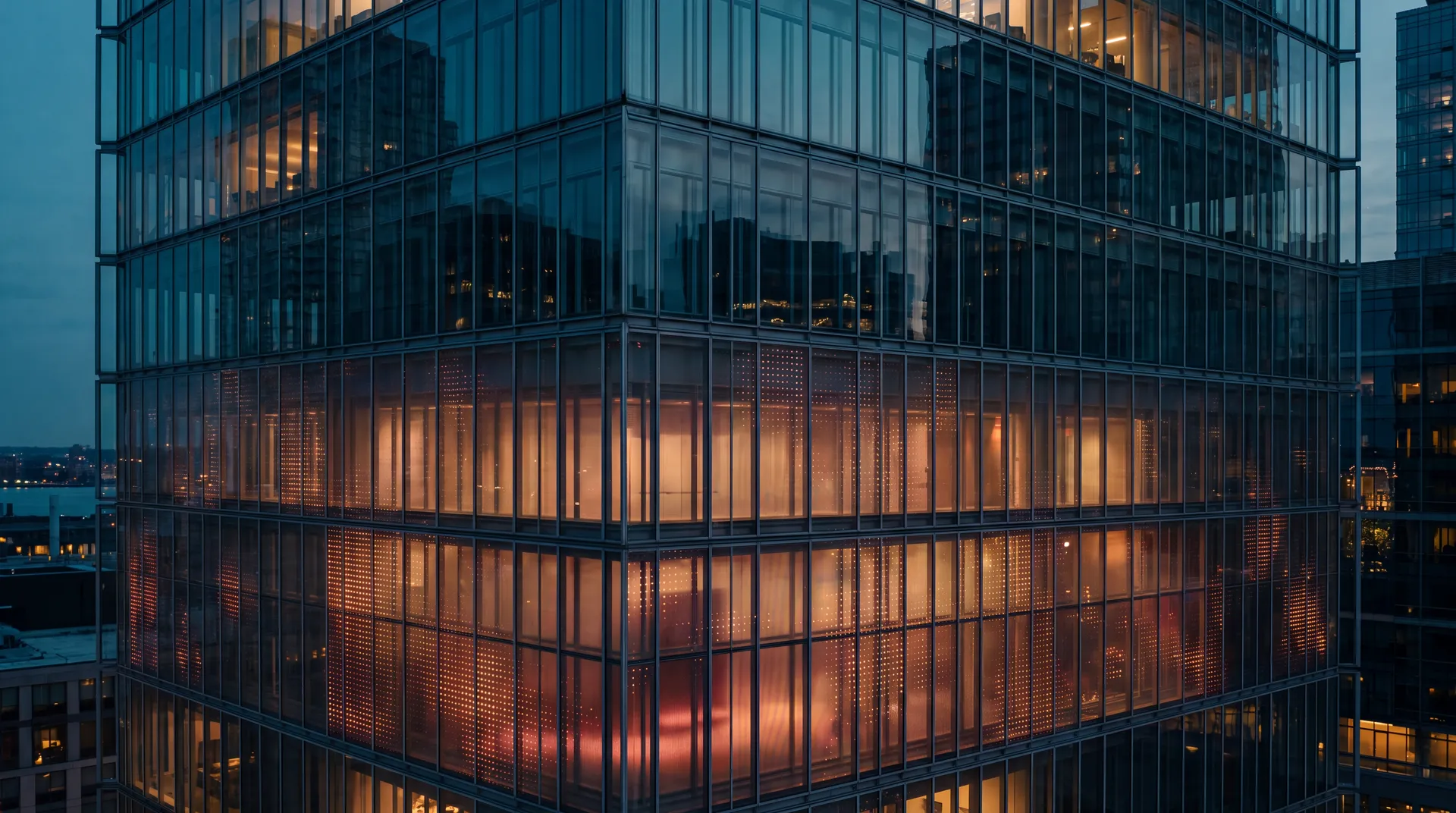
A media façade is a strange object: a building that is also a display. Get it wrong and you bolt a billboard onto architecture, killing both. Get it right and the building gains a voice without losing its form. The difference is almost never resolution or brightness. It is restraint, designed in from the first sketch, not dialled back after install.
Transparency is the whole idea
Unlike a screen, a media façade has to survive daylight as architecture. That means sparse, transparent LED: pixels spaced far enough apart that daylight, views and the building's own material read straight through the skin. By day the façade is a building. After dark, those same points of light resolve into imagery. The single most important design decision is how transparent to make it, because transmittance trades directly against night-time resolution and brightness. Too dense and you have hung a screen; too sparse and the content cannot hold together.
A façade should look like a building that happens to glow, not a screen that happens to be on a building.
Content is the discipline, not the hardware
The geometry is hard: curved and faceted surfaces break the flat rectangle that content is authored for, so imagery has to be remapped per node and calibrated to read from the ground rather than distort across the surface. But the harder discipline is editorial. A façade that plays full-brightness advertising all night is noise. A façade that stays dark until dusk, holds a slow, architectural light for most of the evening, and saves motion for the moments that matter, becomes part of a city's rhythm. The hardware makes it possible; the content decisions make it good.
This is why a media façade is a collaboration, not a purchase. The structure sets what is buildable, the transparency sets what is possible, and the content strategy sets whether the result elevates the building or shouts over it. The technology has been ready for years. The restraint is the rare part.
Bring it to your site
Have a project in mind?
Our team turns these principles into a scoped, specified system for your building.
More from Signal
Market · July 12, 2026
The operator’s screen: what North America’s DOOH market demands
North America is the world’s largest, most mature out-of-home market, and a distinctly operator-driven one. When a display is contracted advertising inventory sold by the second, the hardware spec starts to read like a financial document.
Design · July 12, 2026
What the Gulf is teaching the world about media façades
Nowhere has turned buildings into screens faster than the UAE and Saudi Arabia. The region’s landmark façades are a live lesson in what architectural LED actually has to solve: extreme heat, the transparency trade-off, and a skyline treated as a national asset.