
Specifying · July 8, 2026 · 5 min read
The original blue LED: why the source still decides the screen
Nichia invented the blue LED that made full-colour displays possible. Today the same company builds emitters for cinema projectors and surgical instruments. And when the source is that good, the screen inherits it.
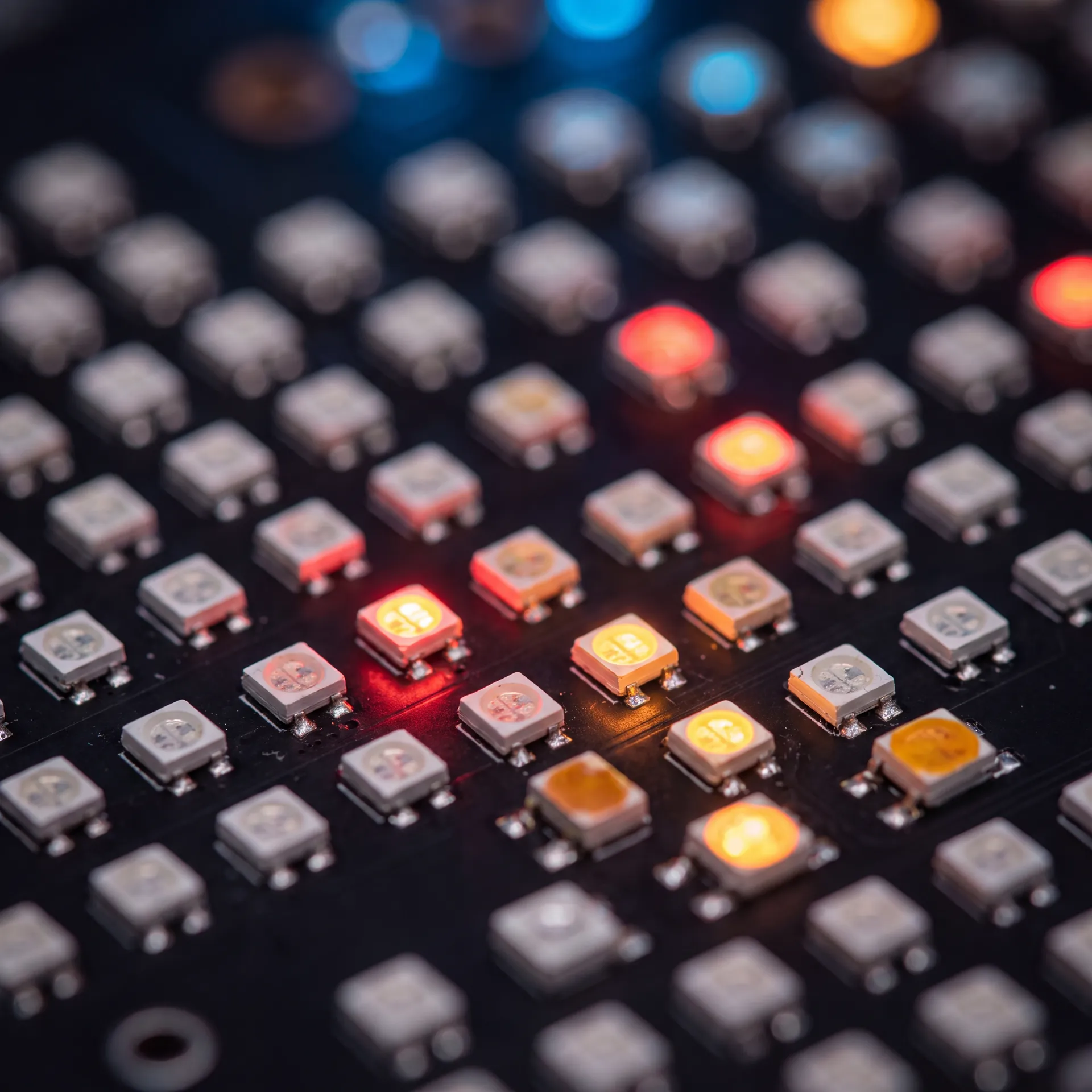
Every full-colour LED screen in the world owes its existence to one breakthrough: the high-brightness blue LED, commercialised by Nichia in the early 1990s, the work that later earned a Nobel Prize in Physics. Before a practical blue emitter there was no white LED and no full-colour video wall; red and green alone cannot make a picture. The company that opened that door is still the reference point for the whole industry.
Breadth is a reliability signal
Nichia’s emitters do far more than drive displays. The same materials science shows up in white LEDs for general lighting, in the blue-and-green laser diodes now replacing xenon lamps in cinema projection (a technology recognised with a Scientific and Technical Academy Award), in UV-C LEDs used for sterilisation, and in laser-diode instruments for minimally invasive surgery. A supplier held to the standards of an operating theatre and a cinema projection booth is a supplier operating on a different plane from a commodity chip vendor.
Why the source matters to a display buyer
Two things separate a premium screen from a commodity one over time: colour stability and lifetime. Both are set at the emitter, before a single module is assembled. Cheaper phosphors drift toward yellow after a few thousand hours of hard use; a tightly-characterised, ceramic-substrate emitter holds its colour and brightness far longer. You cannot calibrate your way out of a chip that shifts: recalibration chases a moving target, and the screen slowly stops looking like the one that was specified.
A manufacturer trusted with cinema projection and surgical instruments can be trusted on a display that has to hold its colour for a decade.
This is why the LED source belongs on the front of the specification, not in the fine print. It is the one decision on a project that no amount of downstream engineering can fully compensate for. Specifying a genuine Nichia emitter is specifying the original, and everything a good manufacturer builds on top of it only pays off because the foundation is sound.
Bring it to your site
Have a project in mind?
Our team turns these principles into a scoped, specified system for your building.
More from Signal
Market · July 12, 2026
The operator’s screen: what North America’s DOOH market demands
North America is the world’s largest, most mature out-of-home market, and a distinctly operator-driven one. When a display is contracted advertising inventory sold by the second, the hardware spec starts to read like a financial document.
Design · July 12, 2026
What the Gulf is teaching the world about media façades
Nowhere has turned buildings into screens faster than the UAE and Saudi Arabia. The region’s landmark façades are a live lesson in what architectural LED actually has to solve: extreme heat, the transparency trade-off, and a skyline treated as a national asset.